
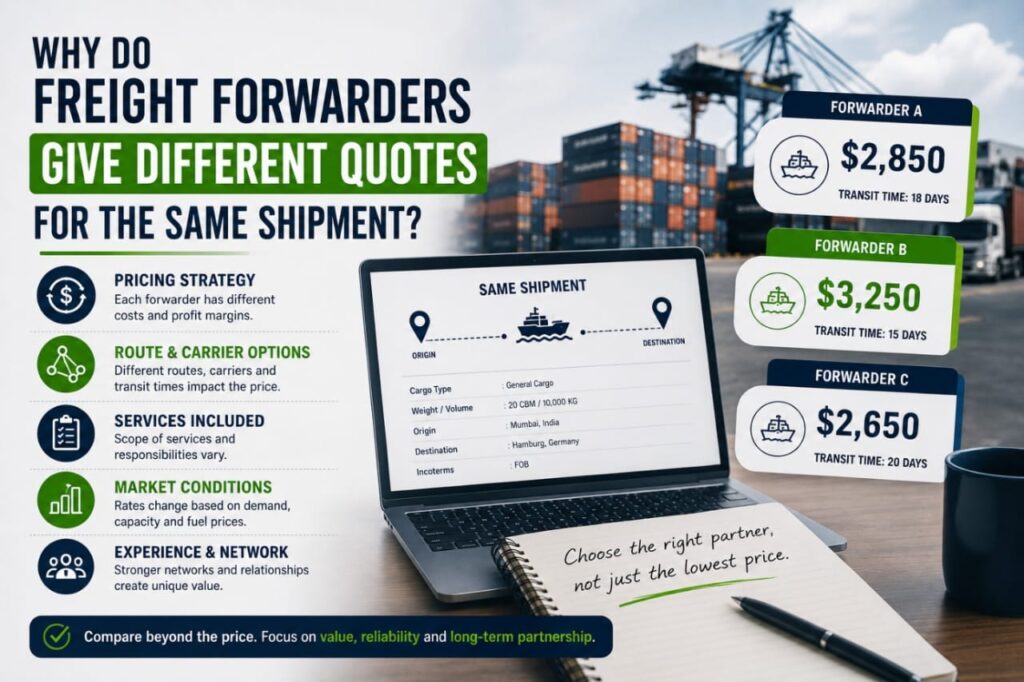
You send the same shipment details to three freight forwarders.
The origin is the same.
The destination is the same.
The cargo is the same.
The weight is the same.
Yet, when the quotations arrive, the prices are completely different.
One forwarder may offer a surprisingly low rate, while another may quote considerably more. Naturally, you start wondering whether someone has made a mistake or whether one company is simply charging too much.
But different freight quotes do not necessarily mean that someone is overcharging you.
The reality is that freight pricing is made up of several moving parts, and freight forwarders do not always arrange the same transportation service in exactly the same way.
The important question is therefore not simply, “Which quote is cheaper?”
It is:
“Why are these quotes different, and am I actually comparing the same service?”
Understanding that difference can help you avoid choosing a quote that looks cheap at first but costs more once the shipment is actually moved.
Freight Forwarders Don’t Always Buy Transportation at the Same Price
A freight forwarder usually does not own every truck, vessel or aircraft involved in moving your shipment.
Instead, the forwarder arranges transportation through carriers and logistics partners.
Different forwarders can have different commercial relationships with those carriers.
Some may have negotiated rates or regular capacity on a particular route. Others may depend more heavily on current market availability. A forwarder that frequently moves cargo on a particular trade lane may have access to options that another provider does not.
This means two forwarders can receive the same shipment request and still have different transportation costs available to them.
The difference can then appear in the quotation you receive.
It is one reason you should not automatically assume that the highest quote is unreasonable or that the lowest quote is the best deal.
The Two Quotes May Not Actually Cover the Same Service
This is probably the first thing you should check when freight quotations look very different.
A freight quote is not just a price for moving cargo between two places. It also describes the scope of the service.
One forwarder may quote port-to-port transportation.
Another may include pickup from your warehouse.
A third may include destination delivery as well.
The three prices can look very different even though everyone is using the same origin and destination.
The same issue can occur with customs clearance, documentation, terminal handling and other services.
Before comparing the totals, check what each provider has actually included.
A lower price does not necessarily mean lower transportation costs. It may simply mean that more services have been left outside the quotation.
Incoterms Can Change What the Quote Covers
For international shipments, Incoterms can have a major impact on who is responsible for different parts of the shipment.
Terms such as EXW, FOB, CIF, DAP and DDP do not represent the same cost responsibility.
If one quotation is based on one set of responsibilities and another is based on a different arrangement, comparing the final numbers directly can be misleading.
This is particularly easy to overlook when a shipper gives the forwarder general shipment details without clearly stating the agreed commercial terms.
If you receive very different international freight quotes, confirm that every provider is working from the same Incoterm and service requirement.
That removes one major source of confusion before you start comparing prices.
Different Routes Can Mean Different Prices
The same origin and destination do not necessarily mean the same route.
A freight forwarder may have several ways to move cargo between two locations.
One option may provide a direct service.
Another may involve a transshipment point.
One may offer a shorter transit time.
Another may take longer but have better availability or lower transportation costs.
These choices affect the price.
That is why it is worth asking the forwarder which carrier and routing the quotation is based on.
A difference in price may be perfectly reasonable if the two quotations are using different transportation arrangements.
The route is not just about geography. It is also about how the cargo will actually travel.
Timing Can Change the Price
Freight rates are not always fixed for long periods.
Capacity, demand, fuel-related costs, seasonal pressure and carrier conditions can affect pricing.
As a result, two forwarders preparing quotations at different times may not have access to exactly the same rate.
Even if you send the same shipment details to both providers, the market conditions behind their quotations may be different.
This is why the date of the quotation and its validity period matter.
If one quote is valid for a few days and another is valid for a longer period, you should not treat them as identical offers.
Always check how long the quoted rate remains valid.
Surcharges Can Make a Big Difference
The base freight rate is only one part of the overall transportation cost.
Depending on the shipment and mode, additional charges may apply for things such as fuel, handling, terminal services, documentation, security or other operational requirements.
The important issue is that forwarders may structure these charges differently.
One provider may include several charges in the headline price.
Another may list them separately.
A third may identify some costs as variable or subject to confirmation.
This is why a quote that appears much cheaper can sometimes become less attractive once all applicable charges are considered.
When reviewing a quotation, don’t stop at the first number you see.
Look at the complete cost structure.
The Forwarder’s Own Costs and Margin Also Matter
Freight forwarders are businesses, and their final quotation includes more than what the carrier charges them.
Each company has its own operating costs, partner arrangements and pricing strategy.
A forwarder may have a larger local network, more staff, different warehouse arrangements or stronger support services. Another may operate with a leaner structure.
Their margins may also be different.
This does not automatically make one company more expensive or another more competitive.
The important thing is to understand what you are receiving for the amount quoted.
A small difference in margin may be worthwhile if the service, communication or operational support is better suited to your shipment.
Destination Charges Can Create a Large Difference
Many shippers focus heavily on the main freight amount and overlook what happens after the cargo reaches the destination.
Destination-related costs can vary depending on the service arrangement, local partner and delivery requirements.
A quotation may include destination handling and delivery.
Another may stop at the port or terminal.
This can create a substantial difference in the final number.
If you are comparing international freight quotations, ask each provider to clearly identify the destination services included in the price.
Otherwise, you may be comparing one complete shipment cost against another provider’s partial cost.
The Same Cargo Can Still Require Different Service Levels
The cargo itself may be identical, but your service requirements can change the price.
For example, you might need:
- Faster transit
- Door-to-door delivery
- Special handling
- Specific pickup arrangements
- Guaranteed or preferred schedules
- Additional documentation support
These requirements can affect the final quotation.
This is why it helps to tell every freight forwarder exactly what you need rather than simply asking for the “best freight rate.”
The clearer your service requirement, the easier it is to compare what each provider is actually offering.
Why the Cheapest Freight Quote May Not Be the Cheapest Shipment
A very low quote naturally attracts attention.
But before accepting it, ask yourself why it is lower.
Perhaps the provider has access to a better carrier rate.
Perhaps the routing is more economical.
Perhaps the company has strong volume on that route.
All of those can be perfectly good reasons.
But there is another possibility: the quotation may simply include fewer services.
Important charges may be outside the quoted amount.
That is why the right comparison is not:
Quote A: ₹80,000
Quote B: ₹95,000
Quote C: ₹1,05,000
Instead, you should ask:
What does each provider include for that price?
Once the services and charges are aligned, the real difference becomes much easier to understand.
How Should You Compare Different Freight Quotes?
The best way is to put the quotations side by side and look beyond the final amount.
Start by checking whether all providers received exactly the same shipment information.
The cargo description, package count, weight, dimensions, origin, destination, transport mode and required dates should be consistent.
Then compare the service scope.
Check whether each quote includes:
- Pickup
- Main transportation
- Origin handling
- Documentation
- Customs-related services
- Destination handling
- Final delivery
- Special services
- Applicable surcharges
Also check the carrier, route, estimated transit time and validity period.
Once these details are aligned, you have a much better basis for deciding which quotation represents the best value.
Ask the Forwarder to Explain the Difference
You do not need to become a freight-pricing expert to understand your quotations.
If one provider is significantly more expensive or cheaper than the others, simply ask.
A useful question is:
“Could you please explain what is included in your quotation and whether there are any charges outside the quoted total?”
You can also ask:
“Which carrier and routing is this rate based on?”
And:
“Are the pickup, destination handling and final delivery included?”
These questions often reveal the reason for a large price difference.
A professional forwarder should be able to explain the main components of its quotation clearly.
Give Every Forwarder the Same Information
If you want a fair comparison, consistency is important.
Send the same shipment information to every provider.
Don’t give one forwarder an estimated weight while giving another the final packed weight.
Don’t tell one provider that you need door-to-door service while asking another for port-to-port pricing.
Don’t give different delivery dates to different providers.
Small differences in the request can produce large differences in the final quotation.
The more consistent your request is, the more useful the comparison becomes.
Don’t Forget About Transit Time
Price is important, but it is not the only factor.
A lower quote may come with a longer transit time.
A higher quote may use a faster service.
If your cargo is urgently required at its destination, saving money on transportation may not be worthwhile if the delay affects your production, customer delivery or business schedule.
When comparing quotations, consider the relationship between:
Price + Transit Time + Service
rather than looking at price alone.
What If One Forwarder Is Much More Expensive?
Don’t reject the quote immediately.
First, find out what is causing the difference.
Ask whether the provider is offering:
- A different carrier
- Faster transit
- A different route
- More services
- Better destination coverage
- Additional handling
- A more comprehensive quotation
If none of these explain the difference, you can then ask the provider to review the rate.
This approach is much more productive than simply telling them:
“Another company is cheaper.”
Give them a chance to explain what is different.
What If One Forwarder Is Much Cheaper?
The same principle applies.
A very low quote deserves a closer look.
Ask what is included and what is not.
Pay particular attention to charges described as:
- Excluded
- Additional
- At actuals
- Subject to confirmation
- Not included
These terms do not necessarily mean the quotation is bad.
They simply mean you need to understand what could be added later.
A cheap quote that excludes services you need may ultimately cost more than a slightly higher quotation that already includes them.
Why Getting Multiple Quotes Can Actually Help
Requesting several freight quotations is not just about finding the lowest rate.
It gives you a better understanding of the available options.
You may discover that:
- One provider has better transit time.
- Another has a more suitable route.
- Another includes more services.
- Another has better availability for your shipment.
- Another offers a more transparent cost breakdown.
This information can help you make a better decision.
It also prevents you from judging the competitiveness of one quotation without knowing what other providers are offering.
How Freight Engage Can Help You Compare Options
If you normally contact freight forwarders one at a time, collecting multiple quotations can become a time-consuming process.
Freight Engage provides a platform that connects freight service users with freight businesses and allows users to request freight quotations from its network. According to Freight Engage, a quote request can be sent to members in the origin and destination countries, who can then contact the requester directly with their quotations.
This can be useful when your goal is to reach multiple freight providers and compare available options, rather than depending on a single quotation.
You can submit your shipment requirements through the Freight Engage quote request process and review the responses you receive.
Request a Freight Quote through Freight Engage
The platform does not remove the need to compare quotations carefully. You should still check the carrier, route, service scope, included charges, exclusions and transit time before choosing a provider.
What Should You Look for Before Choosing a Quote?
Before making a decision, ask yourself a few simple questions.
Are all the quotations based on the same shipment details?
Are they offering the same level of service?
Are the pickup and delivery requirements the same?
Are the same charges included?
Are the carrier and route comparable?
Is the transit time suitable?
Is the quoted rate still valid?
If the answer to these questions is yes, you can make a much more meaningful price comparison.
If the answer is no, the quotations need to be adjusted before you decide which one is actually cheaper.
The Goal Is Not to Find the Lowest Number
Freight transportation is more complicated than simply choosing the smallest price on a page.
A quotation represents a combination of transportation, services, routing, operating costs and commercial terms.
Two forwarders can therefore give different prices for the same shipment without either one necessarily being wrong.
The real problem occurs when the shipper compares those prices without understanding what each quotation contains.
That is when a “cheap” quote can become an expensive shipment.
Final Thoughts
Getting different freight quotations for the same shipment is normal.
Freight forwarders may have different carrier relationships, routes, service arrangements, operating costs and pricing structures. They may also include different charges or work from different assumptions.
So when three quotations arrive with three different prices, don’t immediately ask:
“Which company is overcharging me?”
Start with:
“Are these quotations actually offering the same thing?”
Check the service scope, Incoterm, carrier, routing, transit time, included charges, exclusions and validity period.
Once those details are clear, the price difference becomes much easier to understand.
And if you need more options, reaching several freight providers can give you a broader view of the market and help you make a decision based on more than one quotation.
The best freight quote is not necessarily the cheapest one. It is the quote that gives you the right combination of cost, service, reliability and clarity for your shipment.